What is Jaimal in a Hindu Wedding?
Jaimal, also spelled Jaimala or Varmala, is one of the most auspicious and visually beautiful rituals in a traditional Hindu wedding ceremony. It is the sacred exchange of flower garlands between the bride and groom, symbolizing their mutual acceptance of each other as life partners.
The word “Jaimal” comes from Sanskrit — “Jai” meaning victory and “Mala” meaning garland. Together, it represents the garland of victory and love.
In its most spiritually complete form, Jaimal is performed alongside Vedic Mantrochar — the chanting of ancient Sanskrit mantras by a qualified Hindu priest (Pandit). This elevates the ceremony from a simple ritual to a deeply sacred, spiritually charged moment.
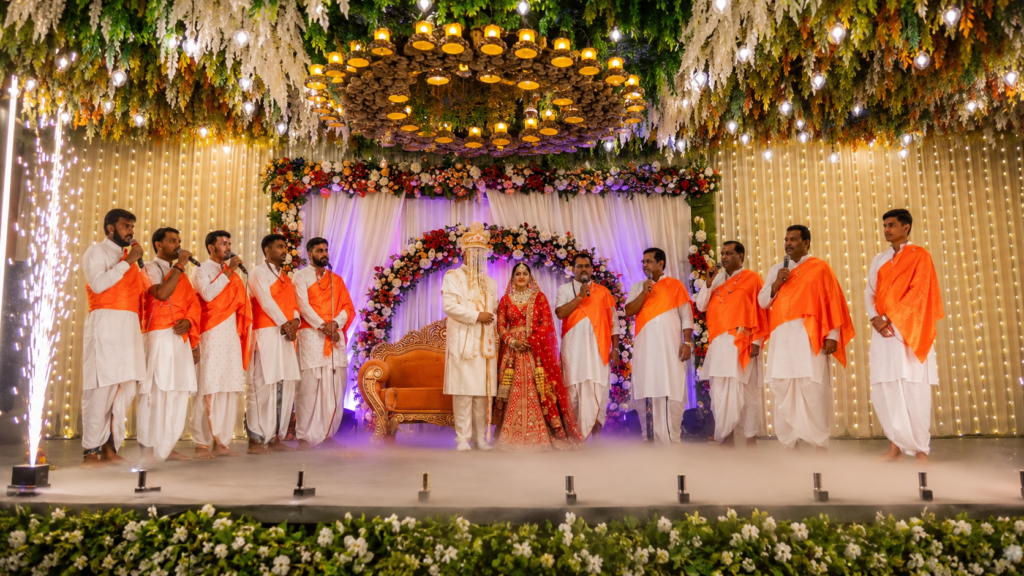
What is Vedic Mantrochar?
Vedic Mantrochar refers to the systematic and rhythmic recitation of Vedic mantras drawn from the four Vedas — the Rigveda, Samaveda, Yajurveda, and Atharvaveda. These mantras are not merely words; they are vibrational sounds that invoke divine blessings, cosmic energy, and spiritual protection.
During a Hindu wedding, Vedic Mantrochar is performed at every key ritual, including Jaimal. The chanting is done by a trained Brahmin Pandit who understands both the phonetic precision and spiritual meaning of each mantra.
The combination of Jaimal with Vedic Mantrochar creates a spiritually sanctified union that is recognized in Hindu Dharma as divinely blessed.
The Significance of Jaimal with Vedic Mantrochar
When Jaimal is performed with proper Vedic Mantrochar, it carries profound spiritual meaning:
- Divine Witness
The mantras invoke gods and cosmic forces — Agni (fire), Vayu (wind), Surya (sun), and Indra — as divine witnesses to the union. - Acceptance and Consent
The garland exchange is an ancient form of mutual consent between bride and groom, done before family, community, and the divine. - Removing Negative Energy
The Vedic mantras chanted during Jaimal are believed to cleanse the aura of the couple and protect them from negative influences (Drishti/Nazar). - Blessings for Longevity and Prosperity
Specific mantras from the Rigveda and Atharvaveda are chanted to bless the couple with a long, healthy, and prosperous married life. - Cosmic Alignment
The timing of Jaimal is fixed according to the Muhurta (auspicious time) determined by Vedic astrology, ensuring the couple begins their journey under favorable planetary energies.
The Step-by-Step Ritual of Jaimal with Vedic Mantrochar
Here is how Jaimal with Vedic Mantrochar is traditionally performed:
Step 1 – Shankh Vadan and Nagara (Conch Shell and Drums)
The ceremony begins with the sound of the shankh (conch) and traditional drums, signaling the beginning of the auspicious moment.
Step 2 – Pandit Begins Mantrochar
The Pandit starts chanting Vedic shlokas and mantras from the Vivah Sukta (marriage hymns), invoking divine blessings.
Step 3 – Groom Enters the Mandap
The groom enters the wedding mandap (sacred altar) while mantras are chanted for his protection and glory.
Step 4 – Bride’s Entry (Var Mala Procession)
The bride enters, often surrounded by her brothers or close family, as the Pandit chants mantras welcoming her as Goddess Lakshmi herself.
Step 5 – The Garland Exchange (Jaimal)
The bride and groom exchange garlands — typically made of fresh flowers like marigold, rose, or tuberose — while the Pandit chants specific Vedic mantras. This exchange is done three times, representing the three worlds (Triloka) and three phases of life.
Step 6 – Ashirwad (Blessings)
After the Jaimal, the Pandit offers special Ashirwad mantras, and family elders bless the couple.
Mantras Chanted During Jaimal – An Overview
During Jaimal with Vedic Mantrochar, the Pandit typically chants the following categories of Vedic mantras:
Mangalashtaka – Eight auspicious shlokas for wellbeing and happiness of the couple.
Vivah Sukta (Rigveda 10.85) – The most ancient and sacred wedding hymn, describing the divine nature of marriage.
Subhavivah Mantras – Mantras specifically composed for the exchange of garlands and the start of the marriage bond.
Nakshatra Shanti Mantra – Chanted according to the birth Nakshatra (lunar star) of the bride and groom for astrological harmony.
Mangalya Dharanam Shloka – A prayer for the long life of the husband and the wellbeing of the family.
Types of Garlands Used in Jaimal
The garland used in Jaimal is not chosen randomly. Traditional Vedic guidelines recommend:
- Marigold (Genda) – Symbol of auspiciousness and the sun’s energy
- Rose (Gulab) – Symbol of love and devotion
- Tuberose (Rajnigandha) – Symbol of purity and fragrance
- Mogra (Jasmine) – Symbol of innocence and divine grace
- Mixed Flower Garlands – Combining all of the above for a complete offering
In royal and traditional Rajput or Brahmin weddings, garlands are also adorned with gold or silver ornaments, coins, and currency notes symbolizing Lakshmi (wealth).
Jaimal in Different Regional Hindu Wedding Traditions
While the core ritual remains the same, Jaimal with Vedic Mantrochar has regional variations across India:
North Indian Hindu Weddings (UP, Rajasthan, Punjab, MP)
Called Varmala or Jaimala, performed with full Vedic Mantrochar under the wedding mandap, often with the groom’s side trying to lift him above the bride’s reach (a playful custom).
South Indian Hindu Weddings (Tamil, Telugu, Kannada, Malayalam)
Called Maalai Maatruthal in Tamil, performed with specific Vedic chants from the Shaiva or Vaishnava tradition, with different flower preferences.
Bengali Hindu Weddings
Called Mala Badal, performed seven times, with Vedic mantras and the bride’s face hidden by betel leaves.
Gujarati and Marathi Weddings
Performed under the Antarpat (a cloth veil) and accompanied by Vedic shlokas from the Grihyasutra tradition.
Why Vedic Mantrochar is Essential in Jaimal
Many modern weddings have simplified the Jaimal to a photogenic moment without Vedic Mantrochar. However, according to Hindu Dharma Shastra, a marriage ritual performed without proper Vedic chanting is considered incomplete.
The mantras serve as the invisible thread that binds the ceremony to cosmic law (Dharma). Without Mantrochar:
The ritual remains a social custom, not a spiritual sacrament
The divine energies are not invoked or made witness
The couple does not receive the full spiritual protection of the Vedic tradition
Choosing a qualified Pandit who performs authentic Vedic Mantrochar during Jaimal ensures the wedding is spiritually complete as per Hindu tradition.
How to Book a Pandit for Jaimal with Vedic Mantrochar
When booking a Pandit for your wedding, ensure the following:
The Pandit is trained in Vedic chanting and can recite from the original Sanskrit texts
Ask if they follow Rigveda or Yajurveda tradition (based on your family lineage)
Confirm the Pandit will chant the Vivah Sukta and Mangalashtaka
Discuss the Muhurta (auspicious timing) in advance
Ensure the Pandit is familiar with your regional customs
Frequently Asked Questions (FAQ)
Q: What is the meaning of Jaimal?
A: Jaimal means “garland of victory.” It is the ritual exchange of flower garlands between bride and groom in a Hindu wedding, symbolizing mutual acceptance.
Q: What is Vedic Mantrochar in a wedding?
A: Vedic Mantrochar is the chanting of ancient Sanskrit mantras from the Vedas by a trained Hindu priest during wedding rituals to invoke divine blessings and sanctify the ceremony.
Q: Is Jaimal mandatory in a Hindu wedding?
A: Yes, Jaimal is considered an essential part of a traditional Hindu Vivah (wedding) ceremony. When performed with Vedic Mantrochar, it is spiritually complete.
Q: How many times are garlands exchanged in Jaimal?
A: Traditionally, garlands are exchanged three times, representing the three worlds, three phases of life, or the three primary deities — Brahma, Vishnu, and Mahesh.
Q: What flowers are used in the Jaimal garland?
A: Marigold, rose, tuberose, and jasmine are the most commonly used flowers. The garland may also be decorated with gold or silver ornaments in royal traditions.
Q: Can Jaimal be performed without a Pandit?
A: While the physical exchange of garlands can happen without a Pandit, Vedic Mantrochar requires a trained priest. Without it, the ceremony lacks its spiritual and scriptural validity according to Hindu Dharma.
Conclusion
Jaimal with Vedic Mantrochar is far more than a photogenic moment in a Hindu wedding. It is a sacred, scripturally grounded ritual that unites two souls under the witness of the divine, guided by the eternal wisdom of the Vedas.
Whether you are planning a wedding in Varanasi, Jaipur, Mumbai, or anywhere in the world, choosing to include authentic Vedic Mantrochar during your Jaimal ensures your marriage begins with the full blessing of the ancient Hindu tradition.
May your Jaimal be auspicious, your mantras resound with divine energy, and your journey together be filled with love, prosperity, and dharma.
Other Related Links
LIVE CLASSICAL MUSIC IN WEDDING
PRE WED SHOOT ON GHATS OF BANARAS