Every evening in Varanasi, as the sun touches the horizon and the sky turns the colour of marigolds, something extraordinary happens at the ghats of the Ganga. Priests dressed in saffron robes take their positions. Brass lamps filled with ghee flames are raised in perfect synchrony. Conch shells sound. Bells ring. Thousands of diyas begin to float on the sacred river. This is the Ganga Aarti — and it has been performed here, every single day, without interruption, since before recorded history.
Now imagine this happening at your wedding.
The Ganga Aarti wedding event is the most requested and most spiritually powerful experience that Kashika Events provides. This complete guide explains everything — what the ceremony involves, which rituals are performed, what is included when you book, what it costs, and why thousands of couples from across India and the world are now choosing this sacred ceremony as the centrepiece of their wedding day.
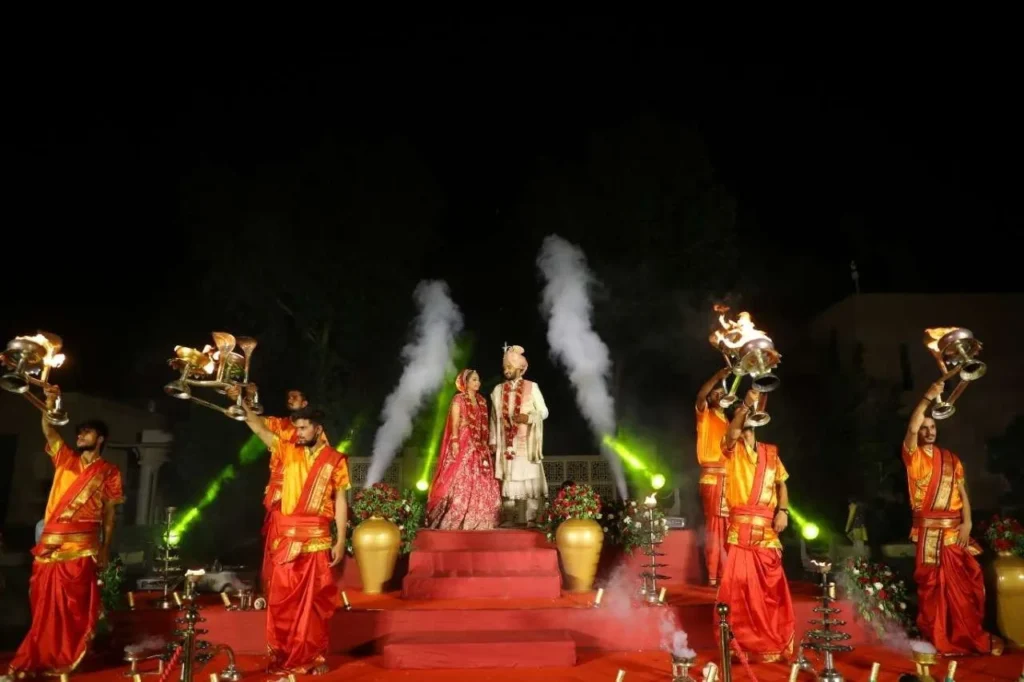
What Is a Ganga Aarti Wedding Event
A Ganga Aarti wedding event is the incorporation of the sacred Ganga Aarti ceremony — the ritual offering of fire, light, and devotion to Maa Ganga — into a wedding celebration. It is not a decoration. It is not a light show. It is a real, authentic Vedic ritual, performed by trained priests from Varanasi, that transforms a wedding moment into a spiritual experience.
The concept was born in Varanasi and has been gaining extraordinary popularity across India over the past decade. Couples who have seen the Ganga Aarti at Dashashwamedh Ghat in Varanasi and want to bring that same sacred energy into their wedding — whether in Varanasi itself or at any venue across India — now have a way to do it.
At Kashika Events, we have been designing and performing Ganga Aarti wedding ceremonies for over twelve years, across hundreds of weddings in Varanasi and beyond. Every element — the priests, the lamps, the rituals, the timing, the music — is authentic and drawn directly from the living tradition of Kashi.
Why Couples Choose a Ganga Aarti Wedding Event
Most Indian weddings are beautiful. A Ganga Aarti wedding event is different in kind — not just in degree. Here is why couples across India are making this the centrepiece of their celebration:
It is deeply spiritual, not just visually stunning. The Ganga Aarti is one of Hinduism’s most ancient and continuously performed rituals. When it is performed at your wedding, the ceremony carries five thousand years of devotion. Guests who have attended dozens of weddings say they have never experienced anything like it.
It makes every moment of the Jaimal unforgettable. The most popular use of the Ganga Aarti in weddings is during the Jaimal — the varmala or garland exchange ceremony. When the couple exchanges garlands as trained priests perform the Aarti with synchronized flame lamps, Shankhnaad echoes across the venue, and flower petals fall — this creates a moment that guests talk about for years.
It creates extraordinary visual memories. The combination of brass lamps, fire, diyas, saffron robes, incense smoke, marigolds, and the golden light of the flames creates photographs and wedding videos unlike anything else. In the era of Instagram and reels, the Ganga Aarti wedding event is one of the most visually distinctive and emotionally powerful things you can film.
It is a genuine blessing, not a performance. The priests who perform the Aarti at your wedding are the same priests who perform it at the ghats. The mantras are real. The ritual is complete. The couple and their families receive genuine spiritual blessings through the ceremony — not a staged recreation of one.
What Is Included in a Ganga Aarti Wedding Event by Kashika Events
When you book a Ganga Aarti wedding event with Kashika Events, here is exactly what is provided:
Trained Varanasi priests in traditional Aarti attire: A team of priests dressed in the saffron and white robes of the Dashashwamedh Ghat tradition, trained specifically in the performance of the Ganga Aarti. The number of priests is determined by the scale of your wedding — from five to eleven, matching the grandeur of the ceremony.
Authentic Aarti lamps and ritual items: The original large brass Aarti lamps used in the ceremony, along with ghee diyas, incense sticks, flowers, conch shells, and all items required for the complete ritual. Nothing is substituted or simplified.
Shankhnaad — conch shell ceremony: The Shankhnaad is the sounding of the sacred conch shell that announces the beginning of a divine ritual. At your wedding, the Shankhnaad at the start of the Ganga Aarti signals to every guest that something sacred is beginning. It stops a room in a way nothing else does.
Synchronized Aarti performance with mantras: The priests perform the full Ganga Aarti — waving the lamps in synchronized patterns while chanting the sacred Aarti mantras. The coordination, the sound of the chanting, and the visual of the flames moving in unison creates an atmosphere of profound sacredness.
Flower shower during Jaimal or Varmala: At the moment of the garland exchange, the ceremony includes a shower of flower petals — marigold and rose — timed precisely with the peak of the Aarti performance. This is the moment that produces the most extraordinary photographs.
Floating diyas on water or decorated surface: The ceremony concludes with the release of diyas — small clay oil lamps — either on the Ganga itself for weddings in Varanasi, or on a decorated water feature, pool, or ceremonial surface for weddings elsewhere. The couple floats the first diyas together as a symbol of their shared life and prayers.
Background devotional music: Throughout the Aarti ceremony, live devotional music — tabla, harmonium, and vocals — provides the same sonic backdrop that accompanies the Aarti at Dashashwamedh Ghat. The music is not separate entertainment. It is part of the ritual.
The Rituals — Step by Step
Understanding the sequence of the Ganga Aarti wedding ceremony helps you and your family appreciate the depth of what is happening. Here is how Kashika Events typically conducts the ceremony:
Preparation and sanctification of the space: Before the ceremony begins, the priests purify the ceremony area with Gangajal — holy water from the Ganga — and set up the ritual arrangement. This preparation itself is a ritual, performed with mantras, and it changes the energy of the space in a way that guests notice even before the ceremony formally begins.
Invocation — calling the presence of Maa Ganga: The priests begin by chanting the invocation mantras that call the presence of the goddess Ganga into the ceremony. In Vedic understanding, the Ganga is not a river alone — she is a living deity. The invocation brings her blessings into your wedding.
Shankhnaad — the conch announces the sacred moment: The blowing of the conch shell signals the formal beginning of the Aarti. At a Kashika Events wedding, the Shankhnaad is used to announce the arrival of the couple for the Jaimal — so that when the couple enters and the conch sounds, every guest in the room immediately understands they are witnessing something sacred.
Synchronized Aarti with lamps — the main ceremony: The priests take their positions and begin the Aarti with the large brass lamps. The movements are synchronized — left to right, up and down, circular — in patterns that have been part of the Varanasi Aarti tradition for generations. The chanting of the Aarti mantras fills the space.
Jaimal or Varmala — garland exchange during the Aarti: The couple exchanges garlands at the peak of the Aarti ceremony, with the priests’ lamps raised behind them and the flower shower beginning. This is the most photographed and most emotionally powerful moment of the ceremony.
Diya lighting and floating — closing blessing: The ceremony closes with the couple lighting diyas together and releasing them. The priest offers a final blessing over the couple with the Aarti lamp — passing the sacred flame over the couple’s joined hands — before the ceremony concludes.
Ganga Aarti Wedding Event in Varanasi — On the Ghats
For couples who are marrying in Varanasi itself, the Ganga Aarti wedding event takes on its fullest and most powerful form. The ceremony can be performed at several locations:
Dashashwamedh Ghat: The most famous ghat in Varanasi, where the main evening Aarti takes place daily. For weddings, Kashika Events coordinates the ceremony timing with the ghat authorities, creating a wedding ceremony that either precedes or is integrated with the main Aarti. Standing at Dashashwamedh for your Jaimal, with the Ganga behind you and the flames of the Aarti reflected in the water, is an experience with no equivalent anywhere on earth.
Assi Ghat: The southernmost major ghat, known for its quieter, more intimate character. Assi Ghat is ideal for smaller, more private Ganga Aarti wedding ceremonies where the couple and their guests want the ritual without the large crowds of Dashashwamedh.
Private Ghats: Several ghats in Varanasi are privately owned by old Banarasi families and can be arranged for exclusive use for a wedding ceremony. Kashika Events has relationships with the owners of several private ghats and can arrange exclusive access for intimate wedding parties.
Boat on the Ganga: One of the most extraordinary formats is the Ganga Aarti performed on a decorated boat on the river itself, with the couple’s boat accompanied by priests performing the Aarti as you drift past the illuminated ghats. The Ganga at night, seen from the water, with the Aarti flames around you, is an image that does not exist anywhere else in the world.
Ganga Aarti Wedding Event Outside Varanasi
One of the most significant developments in Indian wedding culture over the past several years is the bringing of the Ganga Aarti wedding ceremony to venues across India. Couples in Delhi, Mumbai, Bangalore, Hyderabad, Lucknow, Patna, Kolkata, and hundreds of other cities now incorporate Ganga Aarti into their weddings — performed by authentic Varanasi priests who travel to the venue.
Kashika Events provides this service for weddings anywhere in India. Our priests travel from Varanasi with their instruments, ritual items, and lamps. The ceremony is performed with full authenticity regardless of the venue — hotel lawn, palace courtyard, rooftop, banquet hall, or outdoor marquee.
The only thing that changes when the Ganga Aarti is performed outside Varanasi is the physical setting. The ritual, the priests, the lamps, the mantras, and the spiritual quality of the ceremony remain exactly the same. Gangajal — sacred Ganga water — is carried from Varanasi and used in the ceremony at any location.
What Makes a Ganga Aarti Wedding Event Authentic
Because the Ganga Aarti wedding event has become popular, there are now many vendors offering it across India. The quality and authenticity vary enormously. Here is how to tell a genuine ceremony from a staged performance:
Priests trained at the ghats, not hired performers: Authentic Ganga Aarti priests are trained in the specific ritual tradition of the Varanasi or Haridwar ghats. They have spent years learning the synchronized lamp movements, the mantras, and the ritual sequence. Hired performers who have learned a few movements for commercial purposes cannot replicate this.
Real brass Aarti lamps, not decorative props: The large brass lamps used in the Ganga Aarti are specific ritual objects with specific weights and dimensions. Many commercial operators use lighter, smaller lamps that look similar but create a different visual effect. Kashika Events uses the authentic lamps.
Complete mantras, not background audio: The Aarti mantras must be chanted live by the priests. Playing recorded chanting while priests wave lamps is a common shortcut that completely changes the spiritual quality of the ceremony.
Gangajal in the ritual: Authentic ceremonies use actual Gangajal brought from Varanasi. This is both a ritual requirement and a practical sign that the service provider has a genuine connection to the Ganga tradition.
Experience of coordination with the wedding: The Ganga Aarti wedding ceremony must be timed and coordinated with the other elements of the wedding — the couple’s entry, the Jaimal, the music, the photography positions, the lighting. A team that has only performed the Aarti in isolation, without experience of wedding integration, will create logistical problems on the day.
Ganga Aarti Wedding Event Price
The cost of a Ganga Aarti wedding event depends on several factors: the number of priests, the location of the wedding, the scale and duration of the ceremony, and whether it is being performed in Varanasi or at an outstation venue requiring travel.
For weddings in Varanasi, the ceremony is included as part of Kashika Events’ wedding packages. For destination weddings outside Varanasi, pricing is determined by the distance from Varanasi, the number of priests required, and the setup needed for the specific venue.
The investment in a Ganga Aarti wedding event, relative to other wedding expenditures, is modest. Many couples who have spent significantly on décor, catering, and photography tell us that the Ganga Aarti was the single element that their guests remembered most, and that it cost a fraction of what they spent on flowers or food.
Contact Kashika Events at +91 78088 99232 or info@kashikaevents.in for a detailed quote based on your specific wedding date, location, and requirements.
The Best Time to Have a Ganga Aarti Wedding Event in Varanasi
The Ganga Aarti at Dashashwamedh Ghat takes place every evening at sunset — typically between 6:30 PM and 7:15 PM depending on the season. For weddings in Varanasi, the ideal timing for the Ganga Aarti wedding event is the evening ceremony, timed to coincide with or immediately precede the ghat’s main Aarti.
For the full integration of the Ganga Aarti with the Jaimal ceremony, the best approach is to schedule the Jaimal for the evening, as the sky moves from gold to deep blue. The combination of the fading sunset light, the lamp flames, the floating diyas, and the chanting creates a visual and atmospheric experience that cannot be achieved at any other time of day.
In terms of season, October through February is optimal for outdoor ceremonies in Varanasi. The weather is cool and clear, the Ganga is calm, and the evenings are particularly beautiful. November, during the period of Dev Deepawali, is considered the most sacred and spectacular time of all — the entire city illuminates hundreds of thousands of diyas on the ghats, and a wedding during this period carries extraordinary significance.
Frequently Asked Questions
Can the Ganga Aarti wedding event be performed at any wedding venue, not just in Varanasi?
Yes. Kashika Events performs Ganga Aarti wedding ceremonies at venues across India. Our priests travel from Varanasi with all ritual items, lamps, and Gangajal. The ceremony is fully authentic regardless of the venue location.
How many priests are needed for a Ganga Aarti wedding event?
A complete Ganga Aarti requires a minimum of five priests for the synchronized lamp performance. For grander ceremonies — particularly for the Jaimal — seven or eleven priests create the most visually and spiritually powerful effect. The number is decided based on the scale of the wedding and the space available.
How long does the Ganga Aarti wedding ceremony take?
The core Aarti ceremony itself takes 20 to 30 minutes. With preparation, Shankhnaad, Jaimal integration, and the closing diya ritual, the full ceremony typically runs 45 minutes to one hour. This is integrated into the wedding timeline at the appropriate moment — usually the Jaimal entry, which is the peak emotional moment of the wedding evening.
Is the Ganga Aarti appropriate for all Hindu wedding traditions and communities?
Yes. The Ganga Aarti is a Vedic ritual that transcends regional or community-specific traditions. It has been performed at weddings from all Hindu communities — UP, Bihar, Bengal, Maharashtra, South Indian, and NRI families — with complete appropriateness. The Ganga is revered across all traditions of Hinduism.
Can the Ganga Aarti be combined with the actual Vedic wedding rituals?
Yes, and this is one of the most beautiful combinations. Kashika Events regularly coordinates the Ganga Aarti with the Vedic wedding rituals performed by the main wedding pandit, so that the Aarti forms the spiritual atmosphere within which the wedding mantras are chanted. The two traditions complement each other naturally.
Do we need to be near a river for the ceremony?
No. While a wedding on the banks of the Ganga in Varanasi is the fullest expression of this ceremony, the Ganga Aarti can be performed at any venue. For the diya-floating element, a decorated water vessel, small pool, or water feature is arranged at the venue. The Ganga is not limited to her physical banks — in Vedic tradition, wherever Gangajal is present and the aarti is performed with sincere devotion, the presence of Maa Ganga is invoked.
How far in advance should we book a Ganga Aarti wedding event?
For weddings in Varanasi during the peak season (October to February), we recommend booking at least three to four months in advance. For outstation weddings requiring priest travel, four to six months is advisable. Dev Deepawali dates book out extremely early and require six to twelve months advance notice.
Book Your Ganga Aarti Wedding Event with Kashika Events
The Ganga Aarti wedding event is not something that can be fully described in words. It must be experienced. Every couple who has had it at their wedding says the same thing: it was the moment the wedding became something sacred, not just celebrated.
Kashika Events has performed this ceremony at hundreds of weddings. We know every detail — how to time it with the sunset, how to position the priests for maximum visual impact, how to coordinate the Jaimal entry with the peak of the Aarti, how to make sure the photographers are in the right positions, and how to ensure the couple and their families experience the ceremony as participants, not spectators.
If you are planning a wedding in Varanasi, or anywhere in India, and you want the most powerful, most authentic, most spiritually significant wedding experience available — the Ganga Aarti wedding event is what you are looking for.
Contact us at +91 78088 99232 or info@kashikaevents.in. Tell us your date, your location, and the kind of wedding you envision. We will design the ceremony around your story.
The Ganga has been witnessing unions for five thousand years. Let her witness yours.