In the Sanatan tradition, a child’s journey does not begin at birth. It begins with the thoughts, prayers and intentions of the parents long before the baby arrives. To mark this journey, the tradition gives us three sacred ceremonies, known as sanskars: Garbhadhan (गर्भाधान), Pumsavan (पुंसवन) and Simantonnayan (सीमन्तोन्नयन).
If you are planning a family, recently expecting, or in the middle months of pregnancy, this guide will help you understand what each sanskar means, when it is done, what happens during the ceremony, and how to prepare. We have written it in simple words, so that you can take part with understanding and not just by following instructions.
What is a sanskar, and why do these three matter?
The word sanskar is rooted in the idea of refining and making fit. Sanskar Prakash, the classic Gita Press manual on the sixteen sanskars, quotes the old teachers: a sanskar is that which makes a person or thing fit for a purpose. The text explains that this fitness comes in two ways: by removing flaws, and by adding new good qualities.
It gives a very everyday example. Grain from the field is not eaten as it is. First it is cleaned, with husk and stones removed. Then it is ground into flour, mixed with water, rolled and cooked, and only then does it become nourishing food. Cleaning is one kind of sanskar, and bringing out new qualities is another. In the same way, the sanskars are meant to refine a human life, helping a person move towards dharma, artha, kama and moksha.
Tradition counts sixteen sanskars in a lifetime, from before birth to the last rites. The Vyasa Smriti begins its list with these words: garbhadhanam pumsavanam simanto jatakarma cha. In other words, the first three on the list, Garbhadhan, Pumsavan and Simantonnayan, come before the child is born. The text describes them as being done mainly for the parents, to prepare the seed and the field, as the old texts say, which in simple terms means preparing the mind, body and home to welcome a child.
A note on what these ceremonies are. These sanskars are religious and cultural practices. They are meant to bring peace, blessings and good thoughts into the home. They are not a substitute for medical care. Please continue regular check-ups and follow your doctor’s advice at every stage.
The three sanskars at a glance
| Sanskar | When it is done | Who takes part | Its heart |
|---|---|---|---|
| Garbhadhan | Before conception, on an auspicious date | Husband and wife, with the priest | Prayer, intention and a blessed beginning |
| Pumsavan | 2nd to 4th month of pregnancy | Husband and wife, with the priest | Protection and good health for mother and baby |
| Simantonnayan | 6th or 8th month of pregnancy | Couple, family and priest | Joy, blessings and welcome |
1. Garbhadhan Sanskar: the prayerful beginning
What the name means
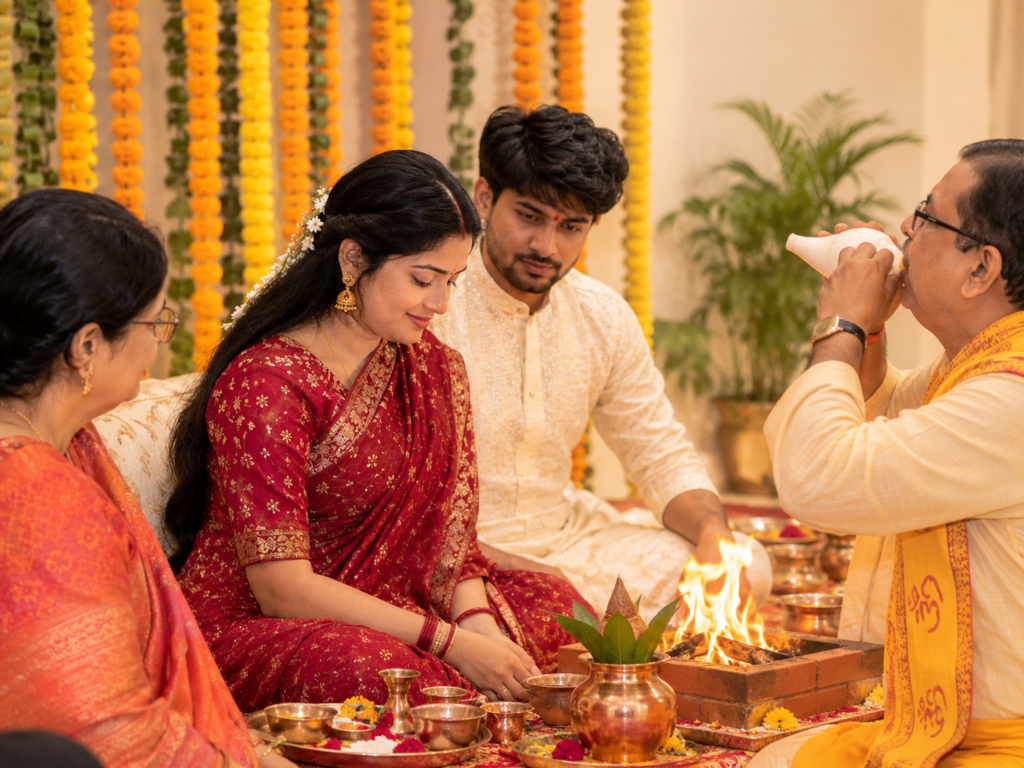
Garbhadhan joins two words: garbha (womb) and adhan (placing, establishing). Sanskar Prakash explains the word plainly. Just as a farmer needs a prepared field before sowing, the tradition asks that parenthood begin with preparation, not by chance. Garbhadhan is the sanskar that turns the natural process of creating life into a conscious, prayerful act.
The text is clear about the spirit of this sanskar. It is not meant to be about worldly pleasure. It is meant as a sacred duty and a prayer for a good child, and the old texts also connect it with the wish to repay one’s debt to the ancestors. The Brihadaranyaka Upanishad, which the book cites, treats this subject in detail. Another verse quoted in the book says that this sanskar removes the flaws connected with the seed and prepares the womb, so that the child who comes is well-prepared in mind and spirit too.
Why it comes first
The book gives a very thoughtful reason for the importance of Garbhadhan. All later sanskars, such as Pumsavan, Simantonnayan and the ceremonies after birth, become possible only once life has begun. Garbhadhan is the starting point, and so the text calls it the most important of the pregnancy-related sanskars. It also says that it completes the Vivah (marriage) sanskar, because marriage begins the couple’s shared life and Garbhadhan begins their journey as parents.
The right time
Traditionally, Garbhadhan is done when husband and wife are both healthy and ready for a child, when they know each other’s hearts, and when both truly wish for a child. The text asks that it be performed at the right time in the woman’s cycle (ritukal), and that certain days are avoided. The book lists days, tithis and nakshatras considered unfavourable, and others considered auspicious, quoting the Muhurta Chintamani, a standard work on auspicious timings.
This is exactly why a priest is needed. Calculating the muhurat depends on your own dates and on the panchang. At Kashika Events, our priests suggest a suitable date once you share your details.
The mindset: thoughts that shape the home
One of the most beautiful ideas in this chapter is about bhavana (inner feeling). The book quotes the Sushruta Samhita and the Narada Purana: the child carries the quality of the thoughts, food and conduct of the parents at the time of conception. A couple who approach this moment with worship, cleanliness and goodwill create a very different atmosphere from one who treat it casually.
This is why the sanskar asks for devotion before everything else. The couple are meant to pray together, keep a calm and joyful mind, and hold the sincere wish for a good, healthy and dharmic child.
What happens in the ceremony
The Gita Press manual describes the procedure in two forms: a complete method, and a simpler short method for those who cannot sit through the full rite. At Kashika Events, we offer both.
What the priest performs:
- Muhurat guidance on a suitable date
- Sankalp (the sacred resolve) taken with the couple’s gotra and names
- Ganesh-Ambika puja and Svastivachan (invocation for peace and blessing)
- Matrika puja, Vasordhara and Ayushya mantras
- Nandimukh shraddha (remembering and honouring the ancestors)
- Recitation of the Garbhadhan mantras
What the couple performs:
- The sankalp, seated together
- A private portion of prayer and a few short mantras, which the priest teaches in advance
- Next morning: a bath, followed by the sankalp for Brahmin bhojan and dakshina
On privacy: the personal portion of this sanskar is private. The priest does not attend it. Our priests teach you the mantras and their meaning beforehand, so you can say them with understanding, in your own space and at your own pace.
The short form: if your family cannot sit through the full rite, the tradition itself describes a simpler method, where the priest recites the mantras and the family completes the actions.
Is it done every time?
Garbhadhan is needed only once, before the first pregnancy. The book adds a gentle note: if, through lack of knowledge, a couple did not do it before their first conception, it may be done before a later one.
Living the pregnancy with care: guidance from the old texts
After conception, the tradition turns to the mother’s day-to-day life. Sanskar Prakash gathers advice from the Matsya Purana, the Sushruta Samhita and the Charaka Samhita, and presents it as simple good sense for an expecting mother.
- Keep the mind peaceful and positive. The texts say that what a mother sees, hears, reads and eats has an effect on the child. She is encouraged to read uplifting books, listen to bhajans and kirtan, and spend time in satsang, and to avoid disturbing or ugly sights and sounds.
- Eat light, fresh, nourishing food. The texts recommend food that is fresh, pleasant and easy to digest, and advise against stale or spoilt food.
- Avoid strain, fear and anger. The texts advise against heavy exertion, sorrow, fear, quarrels and sleeping at odd hours, and encourage rest and cheerfulness.
- Stay clean, dressed well and joyful. The mother is encouraged to wear clean clothes, to keep her surroundings pleasant, to serve and respect elders, and to keep a smiling face.
- Honour her wishes (dohad). The tradition says that a mother’s cravings during pregnancy are to be respected. The Yajnavalkya Smriti and the Sushruta Samhita say that a mother’s wishes should be fulfilled, as long as the things she wants are healthy for her. The book also tells you to avoid foods and activities that may harm the baby.
- Husband’s duties. The texts also list customs for the husband during pregnancy, such as avoiding long journeys and certain rituals. These customs vary from family to family and region to region.
The book also recalls stories from the Puranas and the Mahabharata, of how Prahlada grew up devoted because his mother heard sacred stories during pregnancy, and how Abhimanyu is said to have learnt the secret of the chakravyuha while still in his mother’s womb. Whether we take these as history, faith or inspiration, they carry one clear message: a peaceful mother and a happy home matter.
We present all this as the tradition’s own wisdom. Please keep your doctor’s advice first, especially for diet, rest and activity.
2. Pumsavan Sanskar: a blessing of protection
What it means
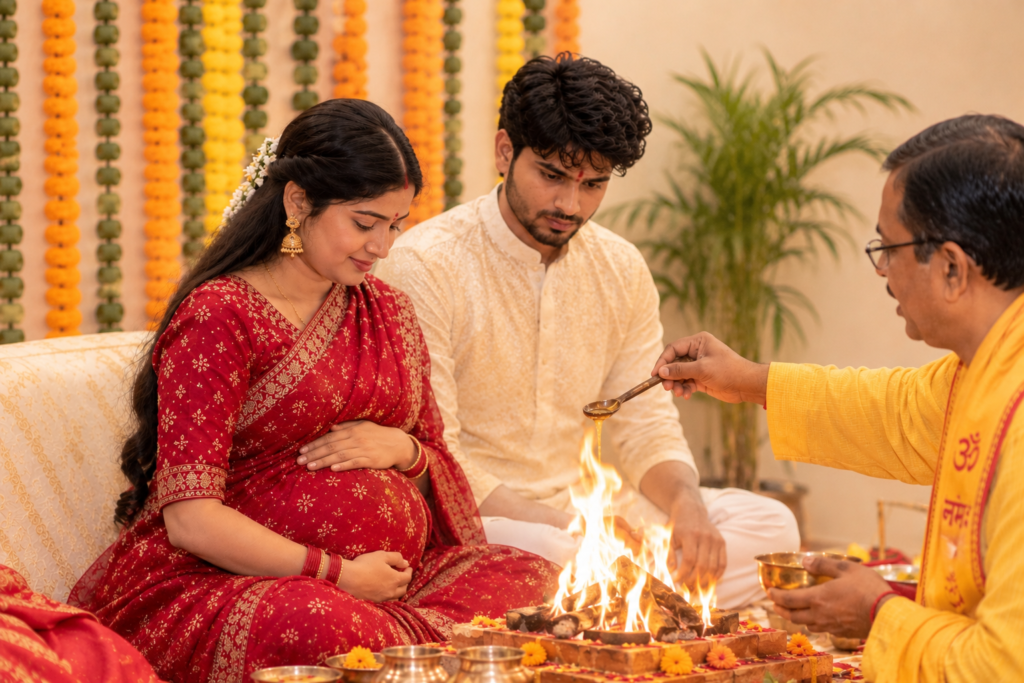
Pumsavan is the first sanskar done after conception. The book describes it as a sanskar for the baby’s time in the womb, done in the early months when the mother needs the most care and protection. In simple words: it is a ceremony of protection and blessing, asking for the safety and good health of the mother and the baby.
The Sanskar Prakash explains that the word Pumsavan is understood in two ways. One looks at the word savan, which means movement or stirring, and says the rite is done when the baby begins to stir in the womb. The other is the traditional Sanskrit derivation of the name, which connects it with the old wish for a worthy child and for the continuation of the family line.
At Kashika Events, we present Pumsavan as a spiritual and cultural practice of protection and nourishment. We do not make any promises about a child’s sex or any other outcome. Please also note that determining or selecting a baby’s sex is illegal in India, and no sanskar can or should be used for that purpose.
When it is done
The book gives the time as the 2nd, 3rd or 4th month. Quoting the old texts, it says that if the signs of pregnancy are clear in the third month, the sanskar can be done then, and if they are not clear until later, it is done in the fourth month. If for any reason the right time passes, the tradition allows Pumsavan to be done together with Simantonnayan in a single sitting. Our priest chooses the muhurat for you.
Like Simantonnayan, Pumsavan is done once, at the first pregnancy. Sanskar Prakash notes that these two are seen as sanskars that refine the mother and the womb, so they are not repeated with every child. The book also reminds readers to follow their own family and regional custom.
What happens in the ceremony
The ritual takes about half a day. The husband and wife sit together with the priest.
- Sankalp and preliminary worship: the sacred resolve, followed by worship of Ganesh and the Matrikas (the divine mothers)
- The main rite: the central ritual, performed with Vedic mantras. The text describes a traditional herbal preparation made from sprigs of the banyan tree, used in the ritual
- Abhishek: a blessing with water from the kalash, along with mantras
- Dakshina and Brahmin bhojan: the offering and feeding that conclude the sanskar
The book also mentions a related supporting rite, Anavalobhan, or protection of the pregnancy, which is traditionally done together with Pumsavan.
A practical note on the herbal element. Because this is a ceremony during pregnancy, we ask every family to speak to their doctor first about any herbal or food element, and to tell our priest about any health concern. The priest will guide you on how to keep the ritual meaningful and comfortable. Similarly, if the priest advises a fast or light meal on the day, please follow your doctor’s advice for the expecting mother.
What you need
- A muhurat from the priest
- A fast or light meal on the day, as the priest advises
- A samagri (ritual items) list, which we give you in advance
- Husband and wife present together
3. Simantonnayan Sanskar: a joyful welcome
What it means
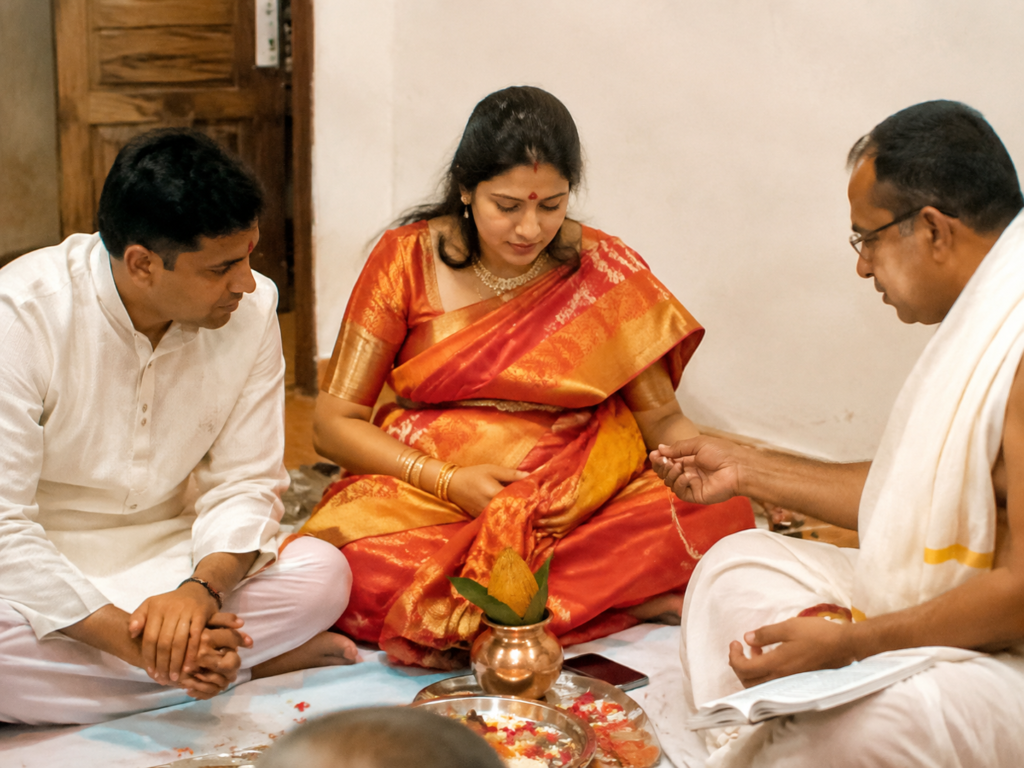
The name has two parts: simanta (the parting of the hair) and unnayana (lifting upward). In a married woman’s life, the parting of the hair is itself a sign of auspiciousness. In this sanskar, the husband gently parts his wife’s hair as a sign of blessing, joy and well-being for her and for the child to come.
The Gita Press text adds a thoughtful detail. The Sushruta Samhita describes the five joints of the skull, which come together at the top of the head, as a tender and sensitive area. The tradition therefore treats this sanskar as a blessing for the baby’s head, mind and mental strength.
If Garbhadhan is a prayer and Pumsavan is a protection, Simantonnayan is a celebration. The tradition says that by this stage the baby is receptive to what the mother feels and hears. This is why the ceremony is filled with devotional music, good stories and happy company.
When it is done
The book states that it is done in the 6th or 8th month of the first pregnancy. Quoting the Parashara Grihyasutra, it says that it is done once, at the first pregnancy, and different families may follow different local customs. Our priest will confirm the muhurat for you.
If Pumsavan was missed in the early months, the old texts allow it to be done together with Simantonnayan, in the same sitting.
What happens in the ceremony
Simantonnayan takes from half a day to a full day, depending on how the family wishes to celebrate.
- Sankalp and puja of Ganesh and the Matrikas
- Havan in the sacred fire, with offerings of ghee
- Charu: a sweet offering, traditionally made of rice and lentils with ghee, prepared and given to the mother as prasad
- The ritual parting of the hair, done by the husband with mantras and with traditional items described in the text
- Music and stories: the text says that skilled veena players are invited to sing about the deeds of a brave king or hero, so that the baby may be inspired by courage and good character. In our ceremonies, this can be veena, devotional music, or stories of heroes
- Blessings from elder married women of the family
- Brahmin bhojan and dakshina to conclude
The mother is seated comfortably, in new clothes, as per custom. Elders and relatives are warmly welcome to attend.
A celebration for the whole family
Many families turn Simantonnayan into a warm gathering, much like a baby shower, but with prayers at its heart. Kashika Events can help arrange the event around the ritual, whether you prefer a quiet family ceremony or a larger gathering.
How the three sanskars fit together
You do not have to start from the same point in the journey. Here is how most families choose:
- Planning conception: begin with Garbhadhan.
- Recently pregnant (early months): choose Pumsavan.
- In the 6th or 8th month: choose Simantonnayan. Pumsavan can be added in the same sitting.
- Following the tradition fully: all three sanskars together.
Frequently asked questions
1. Are these sanskars compulsory? These are religious and cultural traditions. They are practised out of faith and family custom. Many families follow all three, some choose one, and the choice is entirely yours.
2. Do the sanskars replace medical care? No. They are meant to bring peace, blessings and good thoughts alongside regular medical care. Please continue your check-ups, scans and your doctor’s advice.
3. When should we do Garbhadhan? Before conception, on an auspicious date chosen by the priest. It is done once, before the first pregnancy. If it was missed earlier through lack of knowledge, it can be done before a later one.
4. We are already expecting. Is it too late for Garbhadhan? Garbhadhan is a before-conception sanskar, so once pregnancy has begun, the tradition moves to Pumsavan and Simantonnayan. Please call us and we will guide you based on your dates.
5. Does the priest attend the private part of Garbhadhan? No. The personal portion is private. The priest teaches you the mantras and their meaning in advance, and you complete that portion yourselves.
6. What if we cannot do the full ritual for Garbhadhan? There is a short form, in which the priest recites the mantras and the family completes the actions.
7. When is Pumsavan done? In the 2nd to 4th month of pregnancy, on a muhurat. Most traditional guidance points to the 3rd month, or the 4th if the pregnancy only becomes clear later.
8. Does Pumsavan decide the sex of the baby? No. We do not make promises about a child’s sex or any outcome, and selecting a baby’s sex is illegal in India. Pumsavan is a ceremony of protection, blessing and good health.
9. What if we missed the time for Pumsavan? The tradition allows it to be done together with Simantonnayan, in a single sitting.
10. Are Pumsavan and Simantonnayan done for every pregnancy? Traditionally they are done once, at the first pregnancy. Some families follow their own regional customs, so please tell us how your family does it.
11. Why is Simantonnayan done in the 6th or 8th month? The tradition says the baby is more receptive at this stage, and the ceremony is designed to fill the mother’s mind with joy, good music and good stories. It is also a happy occasion for the family to bless the mother.
12. Who can attend Simantonnayan? The couple, the priest, and the family. Elders and relatives are welcome, and elder married women give their blessings to the mother.
13. Is fasting necessary? The priest may advise a fast or a light meal on the day. If you are pregnant, please follow your doctor’s guidance first. Tell us about any health concern, and the priest will adapt the ritual accordingly.
14. What do we need to prepare? Book a muhurat, keep husband and wife available together, and know your gotra and names for the sankalp. For Pumsavan, and for the other sanskars, we give you a written samagri list and a simple timeline in advance.
15. Will we understand the mantras? Yes. We explain the meaning of the mantras, so you can take part with understanding and not just by repeating words.
16. Can Kashika Events arrange a family gathering around the ritual? Yes, especially for Simantonnayan. We can help arrange the event around the ritual, whether you want a quiet family ceremony or a larger gathering.
Packages and how to book
You can book any one sanskar, or all three together.
- Any one sanskar (Garbhadhan, Pumsavan or Simantonnayan): ₹10,000
- All three sanskars (the complete set): ₹25,000, a saving of ₹5,000
What you get:
- A muhurat (auspicious date) chosen for you
- Priests to perform the ceremony
- A written list of items (samagri) and a simple timeline
- The meaning of the mantras explained, so you can take part with understanding
How to book: tell us which sanskar you want and your expected dates. We will confirm the muhurat and send you the details.
- Call us: +91 78088 99232
- WhatsApp: 7808899232
- Website: https://kashikaevents.in
A closing thought
The three prenatal sanskars ask something simple of us: to begin parenthood with prayer, to protect the early months with care, and to welcome the child with joy. Whether you choose one sanskar or all three, we hope the ceremony brings your family peace and blessings, and that it leaves you feeling prepared, supported and happy.
These sanskars are religious and cultural practices and are not a substitute for medical care. Please continue regular check-ups and follow your doctor’s advice.