If you have ever seen a groom arrive at a wedding venue surrounded by blazing torches held high by attendants in royal dress, with dhol, shehnai, and the roar of the crowd filling the night air — you have witnessed a Masal Entry. And if you have not yet planned one for your own wedding, this article will tell you everything you need to know about one of the most dramatic, most culturally rooted, and most unforgettable wedding traditions in India.
A Masal Entry — also spelled Mashal Entry — is the grand procession of the groom and his Baraat, lit by traditional flame torches called Masals or Mashaals, creating a spectacle of fire, music, and royal grandeur that announces the arrival of the groom as a king entering his court. In Varanasi and across North India, the Masal Entry is considered the most auspicious and most visually magnificent way for a Baraat to arrive — connecting the modern wedding to centuries of royal and Vedic tradition.
What Is a Masal Entry?
The word Masal or Mashal comes from the Arabic and Persian word for torch — a long-handled flame lamp that was historically carried by royal attendants to light the path of kings, nobles, and bridegrooms in the night procession to the bride’s home.
In a traditional Indian wedding, the Masal Entry is the moment when the groom’s procession — the Baraat — arrives at the wedding venue accompanied by torch bearers dressed in traditional attire, holding blazing Masals high above their heads. The procession moves to the beat of the dhol, the cry of the shehnai, and the celebration of family and friends — creating a river of fire and music that is impossible to forget.
In Varanasi, the Masal Entry carries particular significance. The city’s connection to Lord Shiva — who himself is depicted in procession with his ganas carrying torches — gives the Masal Entry a deep spiritual and mythological resonance that goes far beyond theatrical spectacle. In Kashi, a Masal Baraat is not just a style choice. It is a living continuation of a sacred tradition.
The History and Cultural Roots of the Masal Entry
The Royal Baraat Tradition
The tradition of torch-lit processions in Indian weddings dates back thousands of years. In ancient India, the groom was celebrated as a king — a Samrat — on his wedding day. The Sanskrit texts and Vedic literature describe the Vivah procession as a royal event, with the groom riding a horse or elephant, surrounded by attendants bearing lamps and torches to light his path and announce his arrival to the world.
This tradition was elaborated and enriched during the Mughal and Rajput eras, when royal weddings became extraordinary spectacles of fire, music, horses, elephants, and thousands of torch bearers. The Masal became a symbol of wealth, power, and divine favor — and the tradition gradually spread from royal courts to noble families to the broader Hindu wedding tradition across North India.
Shiva’s Wedding Procession and the Masal Baraat
In Varanasi, the Masal Entry is inseparable from the mythology of Lord Shiva’s own wedding procession to marry Goddess Parvati. According to Hindu tradition, Shiva arrived at Parvati’s home accompanied by his ganas — his divine attendants — in a wild, ecstatic, torch-lit procession that was simultaneously terrifying and magnificent. The gods, the sages, and the universe itself witnessed this procession.
When a groom in Varanasi enters his wedding in a Masal Baraat, he symbolically follows in the footsteps of Shiva — and that mythological connection gives the moment a spiritual weight that no amount of fireworks or modern entertainment can replicate.
Masal Entry in the Streets of Kashi
Varanasi is perhaps the last city in India where the Masal Baraat has never disappeared. Even today, traditional Banarasi weddings — particularly in the old city areas near the ghats — feature torch-lit processions through the ancient lanes, with Masals blazing above the heads of the crowd, dhol players beating their instruments in the narrow alleys, and the entire neighborhood joining the celebration. This is Kashi at its most alive.
What a Masal Entry Looks Like – The Complete Experience
The Torch Bearers
The heart of the Masal Entry is the team of Masal bearers — traditionally dressed attendants who carry the blazing torches. In a traditional Varanasi Masal Entry, the torch bearers wear kurta-pyjama or angrakha in white, red, or saffron, with a safa (turban) on their heads. They walk in formation on either side of the procession, holding the Masals high and straight, creating walls of fire that frame the groom’s path.
For modern luxury weddings, the Masal bearers can be dressed in custom-designed livery that matches the wedding color palette — gold and ivory, red and gold, navy and silver — turning them into a visual element of the wedding design as well as a functional ceremonial element.
The Masals Themselves
Traditional Masals are long iron rods with a cloth and oil wick at the top that burns with a bright, steady, orange-yellow flame. Modern Masals are made with better fuel and longer burn times, ensuring the torches remain blazing throughout the procession. The number of Masals in a procession ranges from as few as 8 to 10 for an intimate Baraat to 40 to 60 or more for a grand royal-style procession.
The Music — Dhol, Shehnai, and Nagara
No Masal Entry is complete without music. The traditional musical accompaniment for a Masal Baraat in Varanasi includes the dhol — the deep, powerful drum whose sound carries across the entire neighborhood; the shehnai — the sacred wind instrument whose sound in Varanasi carries the energy of Kashi itself; and the nagara — the large ceremonial kettledrum that adds thunder to the procession. Some modern Masal Entries also add brass bands, dhol-tasha groups, or Bollywood dhol fusion teams behind the traditional instruments.
The Groom’s Entry
The groom is the center of the Masal Entry — the king at the heart of the procession. In traditional Varanasi weddings, the groom arrives on a decorated horse — a ghodi — flanked by the Masal bearers. In modern luxury weddings, the groom may arrive in a vintage car, a decorated palanquin, a floral chariot, or simply walking in a procession, surrounded by his family and friends dancing to the music, with the Masals blazing on all sides.
The Atmosphere It Creates
The Masal Entry creates an atmosphere that is impossible to replicate with any other element of a wedding. The blazing torches against the night sky, the deep sound of the dhol, the high cry of the shehnai, the dancing crowd, the smell of the burning Masals, the faces of the family lit by firelight — all of this combines into a sensory experience of extraordinary power. Guests who have never seen a Masal Entry before are invariably stunned. Guests who have grown up with the tradition are moved by it every single time.
Types of Masal Entry for Modern Weddings
Traditional Varanasi Masal Baraat
The classic Varanasi Masal Baraat follows the full traditional format — groom on horseback, 20 to 40 Masal bearers in traditional dress, dhol and shehnai music, family dancing alongside the procession. This format is ideal for traditional Hindu weddings in Varanasi where cultural authenticity is the primary objective. It is the most powerful and most emotionally resonant version of the Masal Entry.
Royal Heritage Masal Entry
The Royal Heritage Masal Entry elevates the traditional format with elements drawn from the Rajput and Mughal royal wedding traditions. The Masal bearers are dressed in custom-designed royal livery. The groom arrives in a decorated palanquin or vintage car. A full brass band or nagara ensemble accompanies the procession. Flower petals and rose water are scattered along the path. This format is ideal for luxury destination weddings and heritage property venues like Brijrama Palace or Taj Nadesar Palace in Varanasi.
Ghat Masal Procession
One of the most spectacular wedding experiences available anywhere in India is the Ghat Masal Procession — a Masal Entry that takes place along the ghats of Varanasi at night, with the Ganga as the backdrop and the blazing torches reflected in the river. The procession moves along the ghat steps, with Masals burning against the dark sky and the river below, while boats decorated with lamps float on the Ganga alongside the procession. This experience is unique to Varanasi and is something that guests will describe to their grandchildren.
Modern Fusion Masal Entry
For couples who want the visual drama of the Masal Entry combined with contemporary wedding entertainment, the Modern Fusion Masal Entry combines traditional Masals and dhol with LED lighting effects, a curated Bollywood or Punjabi music soundtrack, and a choreographed entry for the groom and groomsmen. The Masals provide the cultural authenticity and visual fire, while the contemporary elements add energy and entertainment value for younger guests.
Bride’s Masal Entry
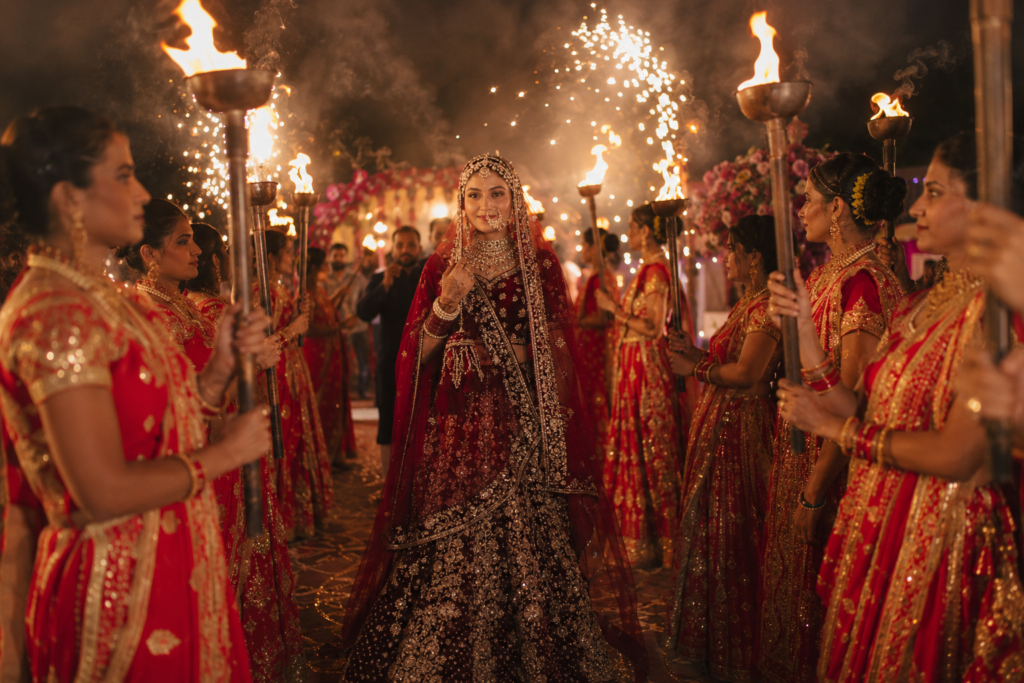
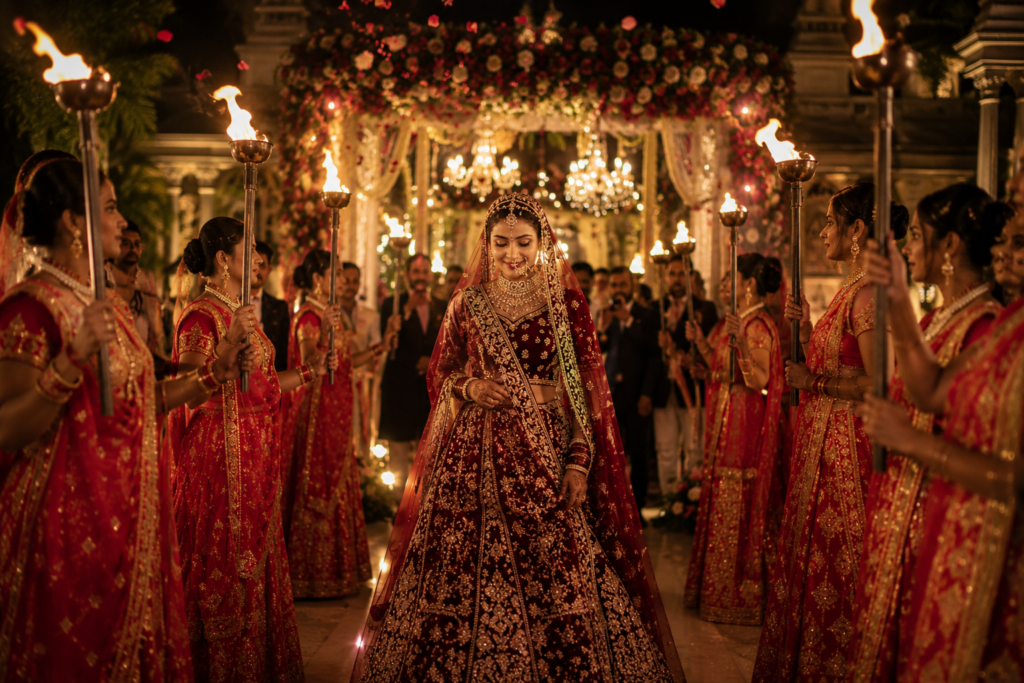
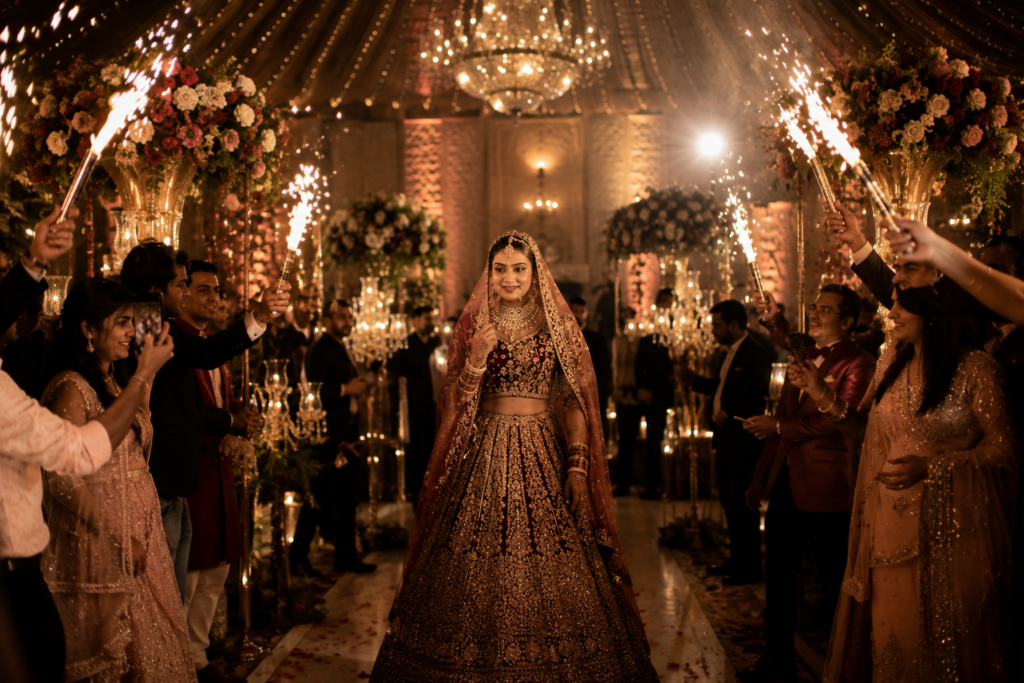
Traditionally the Masal Entry was exclusively for the groom’s Baraat. However, in recent years a growing number of modern couples in India are choosing to give the bride her own Masal Entry — a torch-lit procession into the mandap that gives the bride the same royal welcome that has always been the groom’s privilege. The Bride’s Masal Entry is a powerful statement and creates an extraordinarily dramatic moment when the bride arrives in the blazing light of the torches.
How Kashika Events Manages Your Masal Entry
A Masal Entry looks spontaneous and organic. Behind it is meticulous planning and professional coordination. Kashika Events manages every element of your Masal Entry so that the experience is as seamless as it is spectacular.
We manage the recruitment and costuming of the Masal bearer team, procurement and safety testing of all Masals and fuel, coordination with the dhol, shehnai, and band teams for musical timing, route planning and safety clearance for the procession, coordination with the venue on access and logistics, photography and videography positioning for maximum visual capture of the entry, crowd management and family coordination, and full safety oversight throughout the procession including fire safety protocols and emergency readiness.
Your family dances. Your groom arrives like a king. We make sure everything behind the scenes is perfect.
Frequently Asked Questions
What is a Masal Entry in a wedding?
A Masal Entry is the grand arrival of the groom and his Baraat at the wedding venue, accompanied by torch bearers holding blazing traditional flame torches called Masals, with dhol, shehnai, and music creating a royal and spectacular atmosphere.
Is Masal Entry safe for indoor or covered venues?
Masal Entries are best suited for outdoor venues, open lawns, ghats, and open-air spaces. For partially covered venues, our team conducts a safety assessment and determines the safe number of Masals and the appropriate distance from any covered or enclosed structure. We never compromise on fire safety in any Masal Entry we manage.
How many Masal bearers are needed for a wedding entry?
The number of Masal bearers depends on the scale of your procession and the size of your venue. For an intimate wedding, 10 to 16 Masal bearers on either side of the path creates a powerful effect. For a large grand entry, 30 to 60 bearers is common. Kashika Events recommends the right number based on your specific venue and vision.
Can a Masal Entry be combined with fireworks or flower cannons?
Yes. Masal Entries are often combined with cold pyrotechnics, flower cannons, confetti showers, and LED drone displays for an even more spectacular effect. Our production team designs the combination carefully to ensure that every element complements rather than competes with the others — and that all safety requirements are met.
Is a Masal Entry only for Hindu weddings?
While the Masal Entry has its deepest roots in Hindu and specifically Varanasi wedding tradition, it has been incorporated into Sikh, Jain, and even some Muslim wedding celebrations across North India as a cultural tradition. It is ultimately a celebration of the arrival of the groom — and that joy is universal.
How far in advance should a Masal Entry be planned?
For a standard Masal Entry as part of a wedding managed by Kashika Events, planning begins as soon as the wedding date and venue are confirmed. For a standalone Masal Entry booking — where you are managing the wedding yourself and only want us to manage the Masal procession — we recommend booking at least 4 to 6 weeks in advance, and earlier during peak wedding season.
Can you arrange a Masal Entry for a wedding outside Varanasi?
Yes. Kashika Events arranges Masal Entries for weddings in Patna, Lucknow, Allahabad, Gorakhpur, and other cities in the region. The Masal bearer team, costumes, and all equipment travel from Varanasi to your venue. Contact us with your event location and date for availability and pricing.
Conclusion – Let the Masals Light Your Way
In a world where weddings increasingly look the same — the same decorators, the same DJs, the same entry songs — a Masal Entry stands apart as something genuinely different. It is dramatic without being artificial. It is spectacular without being superficial. It connects your wedding to a tradition that is thousands of years old and to a city — Varanasi — that is the living heart of that tradition.
When the Masals are lit and the dhol begins to beat and the groom appears in the blazing light of the torches, something happens to every person present. The noise, the fire, the music, and the ancient energy of the moment — it does not just entertain. It moves people. It creates a feeling that stays with them long after the wedding is over.
That is what a Masal Entry does. And that is what Kashika Events delivers — every single time.
Contact Kashika Events today to plan your Masal Entry in Varanasi or at your wedding venue anywhere in the region. Let the torches of Kashi light your most important moment.
Contact for Masal Entry – 7808899232
Other Related Links
GANGA AARTI BOOKING FOR WEDDING
BOOK 11 PANDITS FOR MANTROCHAR IN WEDDING